Eating Disorders And Depression In Adolescents – A Common, Underestimated Combination
Depression in Adolescents and Eating Disorders: How Are They Linked?
1.1 When Depressive Symptoms and Disordered Eating Occur Simultaneously
1.2 Why Eating, Body Image and Mood Can Be Closely Linked
1.3 Eating Disorder or Depression: Which Condition Occurs First?
Common Types of Eating Disorders in Young People With Depression
2.1 Anorexia and Depression: Control Between Self-Doubt and Feeling Overwhelmed
2.2 Bulimia: Binge Eating, Shame and Depressive Mood
2.3 Binge-Eating Disorder: When Eating Becomes an Emotional Coping Strategy
2.4 Taking Atypical and Other Eating Disorders Seriously at an Early Stage
Causes and Risk Factors in Adolescence
3.1 Self-Esteem Issues, Perfectionism and a Negative Body Image
3.2 Pressure to Perform, Social Expectations and Stressful Life Events
3.3 Social Media, Body Comparisons and the Desire for Recognition
Recognising Warning Signs and Responding Appropriately
4.1 Physical, Psychological and Social Signs in Everyday Life
4.2 How Can Parents Initiate an Empathetic Conversation?
4.3 When Is Professional Help Needed for Young People?
Treatment of Depression and Eating Disorders at the LIMES Schlossklinik Abtsee
FAQ: Further Questions on Depression and Eating Disorders in Young People
6.1 Can Depression in Young People Trigger an Eating Disorder?
6.2 What Can Parents Do If Their Child Refuses to Eat or Seek Therapeutic Help?
6.3 Can Depression and Eating Disorders Be Successfully Treated at the Same Time?
Depression in young people is not always easy for those around them to recognise. Rather than appearing openly sad, adolescents may react irritably, withdraw or try to cope with their distress through particularly controlled behaviour. If their attitude towards food, weight and body image changes at the same time, this may conceal a link between depressive symptoms and an eating disorder.
Both conditions can develop independently of one another, but they frequently occur together and reinforce each other. For parents this is hard to make sense of: changed eating behaviour looks like a diet, depressive symptoms like normal mood swings of puberty. What matters is therefore not a single behaviour, but the overall picture.
Depression in Adolescents and Eating Disorders: How Are They Linked?
Depression and eating disorders are distinct mental health conditions, yet when they occur together they are almost impossible to tell apart in everyday life: thoughts about food, weight and appearance dictate mood, whilst depressive exhaustion and low self-esteem reinforce the disordered eating.
An eating disorder is not solely about food. Eating behaviour can become the visible expression of deeper-seated conflicts: low self-esteem, high performance expectations, or the feeling of no longer being in control of one’s own life.
When Depressive Symptoms and Disordered Eating Occur Simultaneously
In young people, depression can involve low mood, a lack of motivation and a loss of interest. Irritability, sleep problems or increasing social withdrawal may also occur, and eating behaviour may change alongside them. Typical interactions include:
- Loss of appetite – If reduced appetite turns into highly controlled eating, the line to an eating disorder becomes blurred.
- Eating for comfort – Binge eating briefly masks emptiness, stress or sadness; feelings of guilt follow.
- Withdrawal and secrecy – Shared meals are avoided, and shame leads to eating in secret.
The more the two conditions influence one another, the harder it becomes to break the cycle without support. Diagnosis should therefore consider not only eating behaviour, but equally mood, self-image and family relationships.
Why Eating, Body Image and Mood Can Be Closely Linked
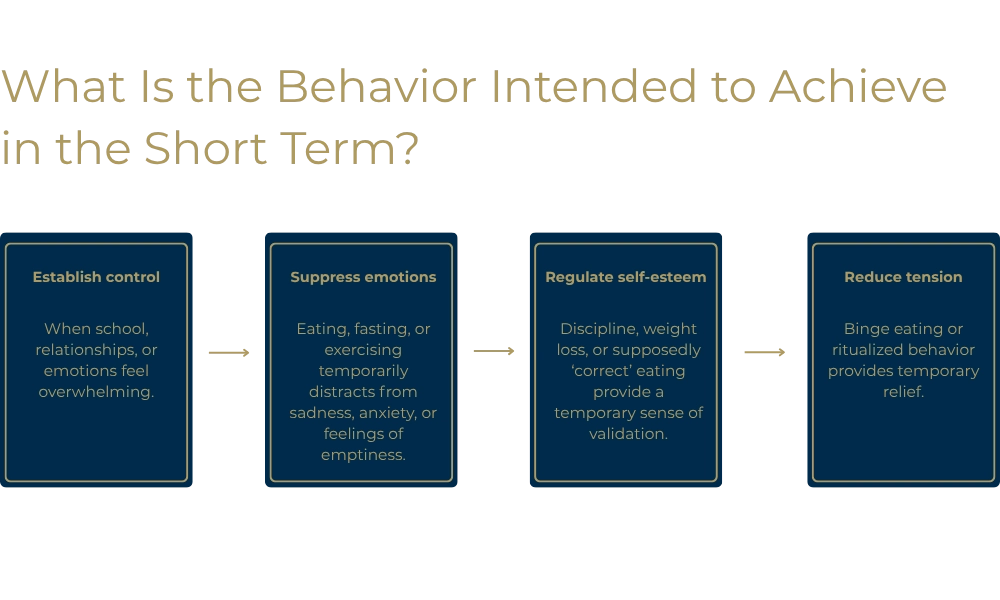
In adolescence the body changes, belonging gains importance and expectations of achievement rise. During this phase, body image is particularly sensitive to outside judgements. Those who view themselves critically may look for an area that appears controllable: eating, weight and exercise offer seemingly clear rules – figures on the scales, calories, portion sizes.
In the short term this provides reassurance; in the long term, life becomes governed by rules and fears. For other young people, eating serves the opposite function – it comforts and distracts, until the effect wears off. Either way, mood becomes dependent on eating behaviour.
Eating Disorder or Depression: Which Condition Occurs First?
There is no universal answer. For some, depressive symptoms come first, and refusing food becomes an attempt to cope with inner emptiness; for others, the mental fixation and isolation of an eating disorder bring on depressive symptoms. Often there is no single trigger at all, but an interplay of predisposition, stressful experiences and family dynamics.
What matters for treatment is therefore less which condition appeared first, than recognising both disorders together: if only eating is stabilised whilst the depressive distress persists, key triggers may be overlooked – and vice versa.
Find out more about depression in young people and the specialised treatment options available.
Common Types of Eating Disorders in Young People With Depression
Eating disorders take many different forms. Not everyone affected is severely underweight, not everyone has visible binge-eating episodes. What is decisive is how far thoughts about food, body and weight restrict daily life.
Anorexia and Depression: Control Between Self-doubt and Feeling Overwhelmed
With anorexia, known medically as anorexia nervosa, those affected severely restrict their food intake; there is often a pronounced fear of weight gain and a distorted perception of the body. Controlled eating initially gives the impression of mastering at least one part of life – whilst self-esteem and mood become tied to whether the self-imposed rules were kept.
Those who feel worthless may perceive weight loss as supposed proof of discipline. Malnutrition additionally increases irritability and withdrawal – at which point it is barely possible to tell which symptoms belong to the depression and which result from the eating disorder.
Bulimia: Binge Eating, Shame and Depressive Mood
With bulimia, binge-eating episodes with a loss of control occur repeatedly. Afterwards, those affected often try to compensate – for example through vomiting, fasting or excessive exercise. Many young people appear outwardly unremarkable for a long time: their weight is not necessarily outside the expected range, and the behaviour usually takes place in secret.
The cycle of tension, binge eating and compensation is accompanied by intense shame: those affected experience their behaviour as a personal failure, and with every further episode hopelessness and self-deprecation grow. If depression is also present, the binge briefly distracts from the emptiness – afterwards, mood usually deteriorates markedly.
Binge-eating Disorder: When Eating Becomes an Emotional Coping Strategy
With binge-eating disorder, too, those affected experience binges with a loss of control – unlike bulimia, however, no compensatory behaviours follow. The episodes often occur when young people feel tense, lonely or overwhelmed: eating calms them briefly, but does not resolve the distress.
Afterwards many feel guilt, disgust or shame. Where depression is present, a distressing cycle develops: the depressive mood triggers the binge, and the binge worsens the mood. Parents should not read this as a lack of self-control.
Taking Atypical and Other Eating Disorders Seriously at an Early Stage
Not every instance of problematic eating immediately meets all diagnostic criteria – the distress can be considerable nonetheless. Adolescents of normal weight or who appear athletic can also be seriously unwell, for example with atypical anorexia. Indications may include:
- Meals are skipped without the person being significantly underweight.
- Food groups are completely avoided out of growing anxiety.
- Binge eating and restrictive phases alternate.
- Body shape and weight increasingly determine self-esteem, mood and daily routine.
It is therefore not a specific weight that is the problem, but the mental constriction.
Causes and Risk Factors in Adolescence
Eating disorders and depression do not arise from a single mistake, a particular upbringing or a lack of discipline. In most cases several factors interact: some increase vulnerability, others trigger symptoms during a stressful phase.
Self-esteem Issues, Perfectionism and a Negative Body Image
Many of the young people affected judge themselves very harshly. Minor mistakes count as personal failure, whilst successes rarely bring satisfaction. The following patterns can be particularly distressing:
- Conditional self-worth – One’s own worth seems to depend solely on achievement, appearance or recognition.
- Black-and-white thinking – Food and body shapes are categorised as ‘good’ or ‘bad’.
- Severe self-criticism – Those affected speak to themselves far more harshly than they would to others.
Within this mindset, an eating disorder often begins as a project of self-improvement: if the hoped-for satisfaction fails to materialise, the rules become stricter – and repeated self-deprecation fuels depressive thoughts.
Pressure to Perform, Social Expectations and Stressful Life Events
Academic pressure, conflicts, bullying or changes within the family place a heavy burden on young people. Transitional phases such as changing schools or moving out of the family home also demand considerable adaptability. The risk rises when several stressors coincide:
- High external expectations clash with pronounced personal perfectionism.
- Familiar structures fall away whilst new demands emerge.
- Rest, sleep, regular meals and social contact take a back seat.
Eating behaviour then takes on a function: it establishes rules, distracts or provides short-term control – whilst persistent stress and the feeling of not measuring up encourage depressive developments.
Social Media, Body Comparisons and the Desire for Recognition
Social media are not automatically the cause of an eating disorder or depression, but they can amplify existing insecurities. Young people see selected, edited snippets of other people’s lives every day – so what is compared is their own unvarnished experience against an optimised public image.
It becomes problematic when appearance or diet turn into the central yardstick for recognition: content about diets, ‘clean eating’ or extreme exercise routines makes restrictive behaviour look healthy. What matters is therefore not only time spent, but also how young people feel afterwards.
Recognising Warning Signs and Responding Appropriately
Not every change in diet or period of withdrawal indicates a mental health condition. Attention is required, however, when changes persist for weeks or affect several areas of life. Parents do not need to make a diagnosis – their role is to notice, remain approachable and seek support where needed.
Physical, Psychological and Social Signs in Everyday Life
Warning signs may occur individually or in combination. A marked change from previous behaviour is particularly significant:
- Around mealtimes – frequent skipping, conspicuously small portions, strict prohibitions or repeatedly disappearing after eating.
- Body and weight – frequent weighing, disparaging remarks about one’s own body, fear of weight gain.
- Psychological changes – low mood, irritability, emotional numbness or a negative self-image.
- Physical symptoms – dizziness, feeling cold, exhaustion or difficulty concentrating.
- Social withdrawal – cancelling meetings, giving up former interests or a decline in performance.
A single sign allows no reliable assessment – it becomes critical when several signals persist over weeks. Gather your observations without commenting on every meal: c
How Can Parents Initiate an Empathetic Conversation?
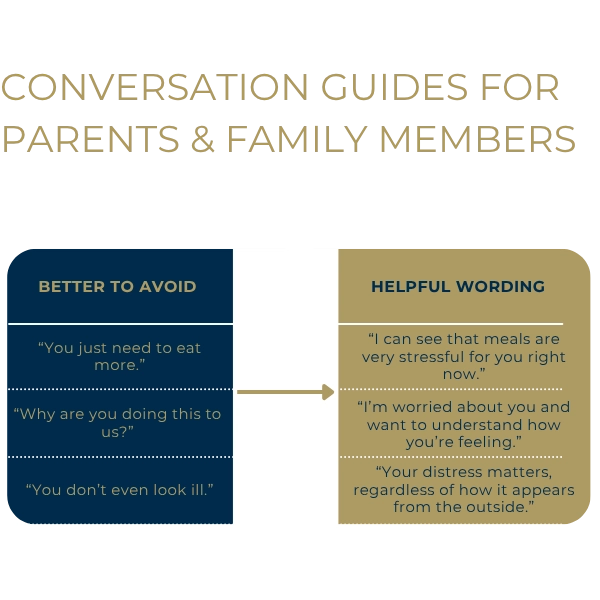
A conversation usually goes better in a calm moment, not straight after a tense meal. Name specific changes without making diagnoses or assigning blame:
- “I’ve noticed that you’ve been withdrawing more often and seem very exhausted.”
- “I get the impression that eating is causing you a lot of stress at the moment.”
- “You don’t have to explain everything straight away. It matters to me that you know I’m here.”
Less helpful are debates about whether the child looks ‘too thin’; ‘Just eat normally’ also underestimates the illness. At the same time, responding with empathy does not mean accepting behaviour that harms their health. The involvement of parents is therefore a key part of treatment.
When Is Professional Help Needed for Young People?
A specialist medical or psychotherapeutic assessment should take place if changes persist or clearly interfere with daily life. Professional help is particularly important if:
- food, weight or body image dominate a large part of the day,
- regular meals are barely possible or binge eating occurs,
- school, friendships and family life increasingly suffer,
- hopelessness, self-harm or suicidal thoughts are expressed.
In cases of acute risk of self-harm, specific suicidal intentions or a medically threatening physical condition, immediate action must be taken: call the emergency services on 112 or go to the nearest child and adolescent psychiatric emergency department.
Young people sometimes refuse help at first – behind this lie shame or the belief that they must solve the problem themselves. Parents can nevertheless arrange an initial consultation.
Treatment of Depression and Eating Disorders at the LIMES Schlossklinik Abtsee
When depression and eating disorders occur together, treatment needs to address psychological and physical symptoms alike. At the LIMES Schlossklinik Abtsee, inpatient treatment in a protected setting is aimed at adolescents and young adults aged 14 to 21. It begins with a comprehensive psychiatric, psychological and psychosomatic assessment, from which an individual treatment plan is drawn up:
- High-frequency psychotherapy in individual and group settings – Depressive thoughts, anxiety and eating disorder symptoms are addressed intensively.
- Behavioural therapy – Recognising rigid eating rules, developing alternative ways of regulating emotions.
- Psychodynamic psychotherapy – A focus on the inner conflicts behind control and changed eating behaviour.
- Nutritional therapy and reliable eating routines – Beyond physical stabilisation, a less anxiety-ridden approach to eating.
- Systemic and family therapy – Family members are involved: not to assign blame, but for communication in everyday life.
- Creative and body-oriented approaches – Art and music therapy, mindfulness, yoga as well as movement and sports therapy open up access to emotions and personal resources.
The protected setting creates distance from a stressful everyday routine, fixed daily structures offer orientation, and where needed individual tuition helps young people stay in touch with their home school. Further information is available in the holistic treatment approach at the LIMES Schlossklinik Abtsee.
Find out more about the personalised therapy programme at the LIMES Schlossklinik Abtsee.
FAQ
Can Depression in Young People Trigger an Eating Disorder?
Depression does not necessarily trigger an eating disorder, but it can create conditions in which problematic eating develops: loss of appetite, emotional emptiness, low self-esteem or a need for control. A single period of reduced appetite does not automatically lead to an eating disorder – it becomes critical when rigid rules, intense anxiety, binge eating or a growing fixation on weight are added.
What Can Parents Do If Their Child Refuses to Eat or Seek Therapeutic Help?
Remain calm, clear and reliable. Pressure or daily arguments about every meal usually lead to further resistance; it is more helpful to raise specific observations and your own concern. At the same time, parents may take responsibility when their child’s health is at risk – for instance with a no-obligation consultation at a specialist clinic. In cases of physical instability, self-harm or suicidal thoughts, professional help must be involved even if the young person rejects it.
Can Depression and Eating Disorders Be Successfully Treated at the Same Time?
Yes. This requires therapy that does not treat the two conditions in isolation: alongside stabilising eating behaviour, depressive symptoms, self-esteem issues and social factors must be taken into account. The course of treatment is not always straightforward. Even if the situation may seem hopeless at first: both conditions are treatable – and the sooner those affected receive help, the sooner entrenched patterns can be changed.
Please contact the LIMES Schlossklinik Abtsee in confidence for a personal consultation.
Categories: Depression Essstörung