Body Image Disorders in Adolescence – When Self-Perception Takes a Toll on Health
Body Image Disorders in Adolescence: When One’s Own Body Becomes a Problem
1.1 What Characterises a Body Image Disorder
1.2 Normal Insecurity or a Condition Requiring Treatment?
Why Young People Are Particularly Susceptible to a Distorted Self-Perception
2.1 Puberty, Identity and Self-Esteem
2.2 Social Media and Permanent Comparison
2.3 Control as an Apparent Solution
Symptoms and Warning Signs of a Body Image Disorder
3.1 Typical Thoughts and Emotional Patterns
3.2 Typical Behaviour in Everyday Life
3.3 Overlaps with Eating Disorders and Depression
How Parents Can Respond Helpfully
4.1 Talking Without Pressure
4.2 When Professional Help Becomes Necessary
Treatment Options at the LIMES Schlossklinik Abtsee
6.1 Is a Body Image Disorder the Same as an Eating Disorder?
6.2 Can Boys and Young Men Also Be Affected by Body Dysmorphia?
6.3 How Can Parents Help Without Constantly Focusing on Appearance?
Body Image Disorders in Adolescence: When One’s Own Body Becomes a Problem
Adolescence is a phase of profound physical, emotional and social change. Adolescents and young adults develop a greater awareness of their appearance, compare themselves more frequently with their peers and seek a stable sense of their own identity. Body image insecurity is not uncommon during this stage of life.
It becomes problematic when preoccupation with one’s own appearance increasingly dominates daily life. A body image disorder can lead those affected to perceive their bodies not realistically, but in a highly negative light. Individual parts of the body then appear flawed, inappropriate or almost unbearable, even though other people often cannot understand this assessment.
This is not a matter of vanity. A body image disorder is an expression of significant inner distress. Self-perception becomes unstable, and looking in the mirror triggers feelings of shame, fear or self-deprecation. Particularly in young people, this can significantly impair personality development, social relationships and academic stability.
What Characterises a Body Image Disorder
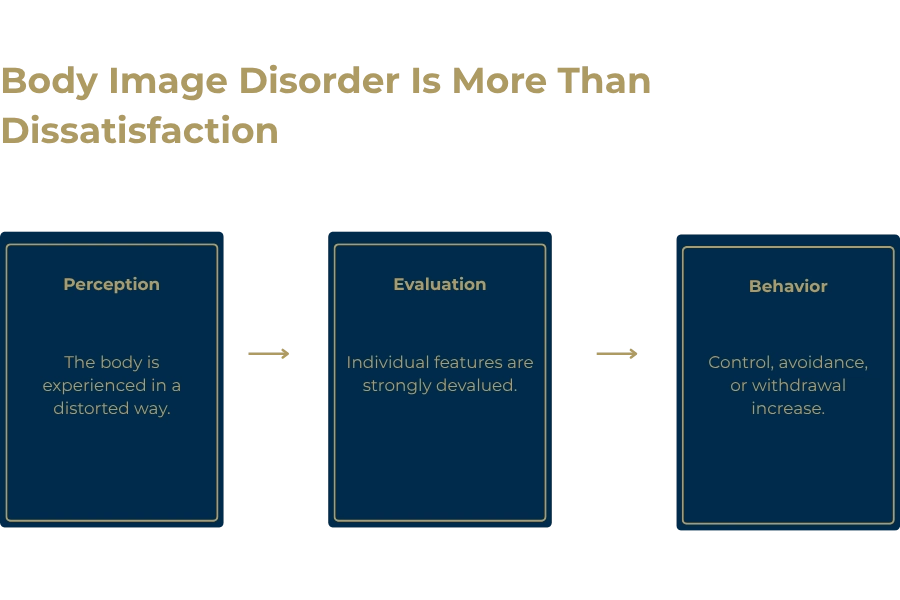
A body image disorder describes a persistently distressing perception of one’s own body or individual physical features. Those affected do not view their body neutrally, but with strong judgement. Often, the impression arises that a particular feature is immediately visible to others or makes them less acceptable.
This distorted self-perception can relate to many areas:
- Skin
- Face
- Hair
- Weight
- Body shape
- Muscle size
- Individual proportions
Some young people repeatedly check their appearance. Others avoid mirrors, photos or situations in which their body might be visible. Typically, reassuring comments from others provide only temporary relief. Even when parents, friends or therapists explain that the supposed flaw is barely noticeable, the distressing feeling persists. The inner conviction is stronger than external feedback.
Normal Insecurity or a Condition Requiring Treatment?
Not all dissatisfaction with one’s appearance is pathological. The decisive factor is the extent to which these thoughts and behaviours dominate daily life. Indications of a condition requiring treatment may include:
- Frequent checking of one’s appearance in the mirror, in photos or using a mobile phone camera
- Significant avoidance of school, leisure activities, sport, swimming pools or social gatherings
- Repeatedly seeking reassurance about one’s own appearance
- Conspicuous concealment of certain body areas through clothing, make-up or posture
A body image disorder should be taken particularly seriously when young people increasingly define themselves by their appearance and other areas of life fade into the background.
Why Young People Are Particularly Susceptible to a Distorted Self-Perception
A body image disorder is rarely caused by a single trigger. Usually, several factors come into play: physical changes, social comparisons, perfectionism, family experiences, media ideals and individual vulnerability. In adolescence in particular, these influences come up against a self-image that has not yet been firmly established.
The body often changes faster than young people can process these changes internally. Growth, skin texture, weight, voice, body hair or sexual characteristics become more visible. At the same time, the importance of recognition increases. Stares, comments or seemingly casual remarks can have a lasting impact.
Puberty, Identity and Self-Esteem
During puberty, the body becomes a central part of identity development. Young people ask themselves: How do I come across? Am I accepted? Do I fit in? If self-esteem is unstable, appearance can become excessively important.
Disturbed self-perception often develops in cases where the body becomes a measure of one’s own worth. The thought “I don’t look right” then connects with deeper beliefs such as “I’m not good enough” or “I will be rejected”.
These patterns can become entrenched when young people repeatedly experience in everyday life that appearance is heavily judged. This applies not only to social media, but also to school, peer groups, family, sport or relationship experiences.
Social Media and Permanent Comparison
Social media alone cannot explain a body image disorder. However, it can amplify existing insecurities. Young people see edited images, idealised bodies and seemingly perfect self-presentations every day. Even when many know that photos are filtered, the emotional comparison remains effective.
Particularly distressing are mechanisms that make one’s own appearance permanently subject to evaluation:
- Filters and image editing: They shift the perception of what is considered normal. Natural features appear more quickly as flaws.
- Likes and comments: Feedback can provide short-term validation, but can also create dependency. One’s own appearance is linked to external reactions.
- Algorithmic repetition: Those who frequently view content about fitness, beauty or diets are often shown more and more similar content.
This is how body dysmorphia can become more pronounced: the body is no longer experienced, but permanently monitored.
Control as an Apparent Solution
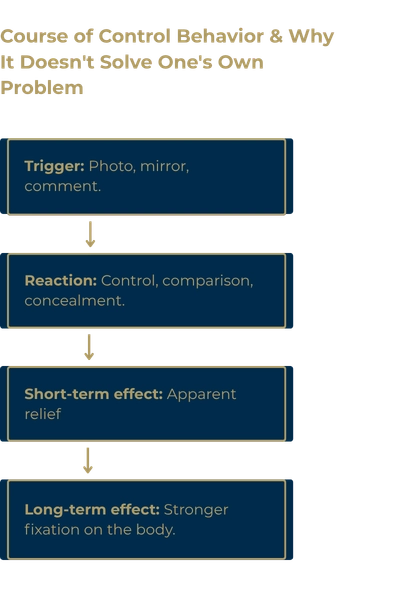
For many of those affected, control plays a central role. Exercise, diet, skincare, clothing or photo selection initially appear to be ways of reducing insecurity. In the short term, this can provide relief. In the long term, however, it can reinforce the fixation.
When the body becomes the only area that appears controllable, a vicious cycle develops: tension, control, brief relief, renewed self-criticism. This cycle can be extremely exhausting for young people.
Symptoms and Warning Signs of a Body Image Disorder
A body image disorder often develops gradually. It may start with isolated feelings of insecurity. Later on, thoughts increasingly revolve around the body. Those affected scrutinise, compare, avoid or seek validation.
It is not always easy for parents to recognise this development. Young people often do not speak openly about feelings of shame, disgust or low self-esteem. Some react irritably when the subject is raised. Others play down the distress, even though they are suffering deeply inside.
Typical Thoughts and Emotional Patterns
Many young people with body image disorders perceive their bodies through a very strict internal filter. Positive feedback is rarely accepted, whereas neutral situations are quickly interpreted as confirmation of their own fears.
Common thoughts include:
- “Everyone can see straight away what’s wrong with me.”
- “I can’t go out like this.”
- “If I looked different, my life would be easier.”
- “I have to control this, otherwise it will get worse.”
- “Others are only saying it isn’t noticeable out of politeness.”
These thoughts are not simply exaggerated or dramatic. For those affected, they feel real. This is precisely why it is usually not enough to refute them with logical arguments.
Typical Behaviour in Everyday Life
Distorted self-perception is often manifested in recurring patterns of behaviour. Some young people constantly check their appearance. Others avoid anything associated with being seen.
Typical behaviours may include:
- Checking behaviour: Mirrors, photos, scales or mobile phone cameras are repeatedly used to check for supposed changes.
- Avoidance behaviour: Sport, swimming, parties, school trips or doctor’s appointments are avoided for fear of being seen.
- Concealment: Clothing, hair, make-up or posture are used to cover up certain areas.
- Reassurance-seeking: Those affected repeatedly ask whether a feature is noticeable, but are only briefly reassured afterwards.
- Researching: Diets, exercise programmes, skin treatments or cosmetic procedures are researched intensively.
If these patterns persist for weeks and restrict freedom, relationships or performance, professional help should be considered.
Overlaps with Eating Disorders and Depression
A body image disorder can occur independently, but it can also be associated with other mental health conditions. There are often overlaps with eating disorders, depression, anxiety disorders, obsessive-compulsive symptoms or self-harming behaviour.
Eating patterns can vary greatly. Some young people reduce their meals, avoid certain foods or count calories. Others experience binge eating, feelings of guilt or a distressing cycle of control and loss of control. Not every body image disorder is an eating disorder. Nevertheless, body perception, eating behaviour and psychological co-morbidities should be considered together. Considering them in isolation often falls short.
How Parents Can Respond Helpfully
Parents are often the first to notice that their child is changing. Perhaps appointments are cancelled, mealtimes become more fraught with conflict, or photo opportunities are avoided. It is common to feel the understandable urge to reassure them quickly: “You look fine” or “You’re just imagining things.” In cases of severe body image disorder, such comments are usually of limited help. They can even lead to young people feeling misunderstood. A more helpful approach is one that takes their distress seriously without validating their distorted self-perception.
Talking Without Pressure
A good starting point does not begin with criticism, but with observation. Parents can say: “I’ve noticed that you’ve been withdrawing a lot lately when it comes to photos or social gatherings. I’m worried and would like to understand what’s troubling you.”
It is important not to impose solutions straight away. Many young people first need to feel that they can speak without being judged or corrected.
The following are helpful:
- Calm conversations in a safe setting
- Acknowledging the distress without confirming the perceived flaw
- Fewer comments about weight, figure, food or appearance in everyday family life
- Clear support in seeking professional help
- Patience if young people initially react defensively
Parents should avoid getting drawn into lengthy discussions about specific physical characteristics. The focus should not be on whether the perceived flaw “really” exists, but on how much the child is suffering as a result.
When Professional Help Becomes Necessary
Professional support is important when daily life is significantly restricted. This includes social withdrawal, truancy, depressive symptoms, anxiety, significant changes in eating behaviour, self-harm or suicidal thoughts.
Even if young people spend a great deal of time checking, comparing or avoiding, the situation should be professionally assessed. The earlier a body image disorder is treated, the more effectively entrenched patterns can be broken. Parents do not need to have all the answers. What matters is taking the distress seriously and making support available.
Treatment Options at the LIMES Schlossklinik Abtsee
At the LIMES Schlossklinik Abtsee, we treat adolescents and young adults within a safe, high-quality and clearly structured therapeutic environment. With a body image disorder, it is not simply a matter of changing individual thoughts about one’s appearance. It is crucial to carefully understand the underlying stressors, issues of self-worth, family dynamics and any possible co-morbid conditions.
The process begins with a comprehensive assessment. In this, we consider not only visible symptoms, but also development, resources, educational situation, relationship experiences and individual treatment goals. A personalised treatment plan is then developed on this basis.
Specific treatment options may include:
- Psychiatric, psychological testing and psychosomatic assessment: This helps to classify the body image disorder and identify possible co-morbid conditions such as depression, anxiety, obsessive-compulsive disorder or eating disorders.
- Individual psychotherapy: Young people can learn to examine self-critical thoughts, work through feelings of shame and develop new strategies for dealing with distressing self-perception.
- Group therapy sessions: Sharing experiences in a safe environment can provide relief and help to gradually reduce social withdrawal.
- Family and systemic therapy: Parents and relatives can be involved if family communication, conflicts or support structures are therapeutically relevant.
- Art, music, movement and relaxation therapy: Complementary approaches can alter one’s relationship with the body. The body is no longer merely judged, but is once again perceived as a tangible part of one’s own person.
- Nutritional support for symptoms of eating disorders: If eating behaviour, weight control or binge eating play a role, the treatment is expanded accordingly.
The aim of treatment is not superficial satisfaction with one’s appearance. The aim is a more stable self-perception, greater psychological flexibility and a daily life that is not permanently dominated by body image.
FAQ
Is a Body Image Disorder the Same as an Eating Disorder?
No. A body image disorder and an eating disorder can overlap, but they are not the same. In a body image disorder, the focus is on a distressing or distorted perception of one’s own body. An eating disorder additionally affects eating behaviour, weight control, experiences of hunger and satiety, or binge eating. As both issues are often linked, a professional diagnosis should determine which symptoms are present in each individual case.
Can Boys and Young Men Also Be Affected by Body Dysmorphia?
Yes. Body dysmorphia does not only affect girls and young women. Boys and young men can also suffer greatly from their body image. Issues such as muscle size, height, skin, hair, facial features or proportions are often the main focus. The distress is sometimes recognised later in boys because shame, insecurity or body image pressure are less frequently discussed openly. This is another reason why an attentive, non-judgemental approach is important.
How Can Parents Help Without Constantly Focusing on Appearance?
Parents can help by discussing individual physical features less and paying more attention to the level of distress. What is important is calm discussions, reliable support and a willingness to seek professional help. It is also sensible to pay attention to language in family life. Frequent comments about weight, diets, figure or appearance can increase pressure, even if they are not directed at the child.